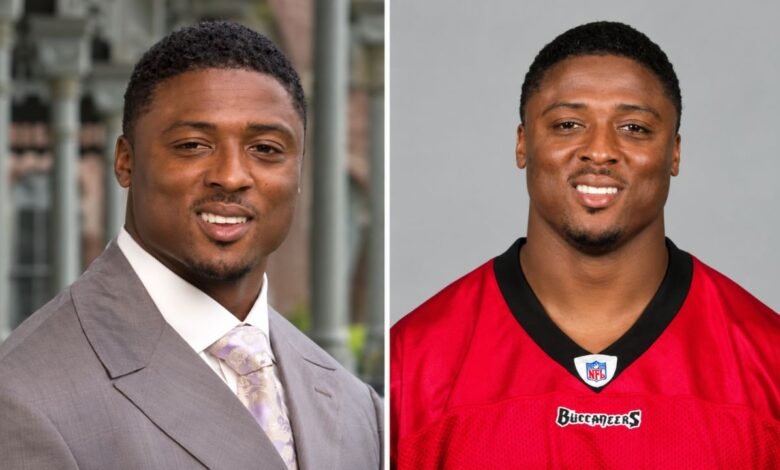
Warrick Dunn: NFL Career, Stats, Net Worth, Wife and Charities
Warrick Dunn is remembered as a successful NFL running back, but his story reaches well beyond football. He spent 12 seasons in the NFL, earned three Pro Bowl selections, and finished his playing career with 10,967 rushing yards. Away from the field, he built a charitable legacy inspired by the loss of his mother and his responsibility toward his younger siblings. His work helping single-parent families pursue homeownership became one of the defining parts of his life after football. From his years at Florida State to his NFL career, business interests and community work, Dunn’s journey combines athletic achievement with a strong sense of family responsibility.
Warrick Dunn’s Early Life and Family
Warrick De’Mon Dunn was born on January 5, 1975, and was raised in Baton Rouge, Louisiana, as the oldest of six children. His mother, Betty Smothers, worked as a police officer and took on additional responsibilities to support her family. Dunn grew up in a household where he learned early that family responsibilities could require sacrifice and persistence. His experiences during childhood later influenced the way he approached both his football career and his charitable work.
A major turning point came on January 7, 1993, when Smothers was killed while working an off-duty security assignment. Dunn was only 18 years old at the time and suddenly had to help take care of his younger siblings. He was also a highly recruited high school football player preparing to make an important decision about his future. Instead of allowing the tragedy to end his ambitions, he continued toward college football while taking on responsibilities normally associated with a much older member of the family.
Dunn eventually used his mother’s life insurance to purchase a home for his younger siblings. That decision became much more than a way to provide immediate stability for his family because it later influenced the creation of his signature charitable program. The experience showed him how much a secure home could mean to a family dealing with financial and emotional pressure. Years later, he would use his position as a professional athlete to help other single-parent families experience that same sense of stability.
Warrick Dunn’s High School Football Career
Before becoming a Florida State star, Dunn established himself as one of Louisiana’s best high school football players. He attended Catholic High School in Baton Rouge, where he played multiple positions during his development. His athletic ability was already clear, but his relatively small frame caused some people to question whether he could succeed at the highest levels of football. Dunn eventually used those doubts as motivation rather than allowing them to define his expectations.
Dunn later described how being overlooked early in his youth football experience helped create a competitive edge. He remembered being selected last when he first tried out for a team as a child, followed by being selected first the following year. That experience became part of a larger pattern in his career, as critics repeatedly questioned whether his size would prevent him from succeeding. His eventual college and NFL careers gave him a long answer to those doubts.
Warrick Dunn at Florida State
Dunn chose Florida State University and played for legendary coach Bobby Bowden from 1993 through 1996. His college career began with an immediate impact because he helped the Seminoles win the 1993 national championship. Florida State finished that season 12-1 and defeated Nebraska 18-16 in the Orange Bowl to claim the national title. Dunn became part of one of the strongest periods in the program’s history.
During his four seasons at Florida State, Dunn became one of the most productive running backs in school history. He rushed 575 times for 3,959 yards and 37 touchdowns while adding 132 receptions for 1,314 yards and 12 receiving touchdowns. He finished his college career with 5,321 all-purpose yards and 49 total touchdowns. His combination of speed, receiving ability and consistency made him a major offensive threat throughout his college career.
Dunn was a three-time First Team All-ACC selection and finished fifth in the 1996 Heisman Trophy voting. He had finished ninth in the Heisman voting the previous year, showing that his reputation had grown steadily during his time in Tallahassee. In 1995, he rushed for 1,242 yards and averaged 7.5 yards per carry, both figures that stood out in the school’s record book. Florida State later retired his No. 28 jersey, reflecting the importance of his contribution to the program.
One of Dunn’s most notable college achievements was becoming the first Florida State player to rush for more than 1,000 yards in three consecutive seasons. He also finished his college career as the school’s leader in career rushing yards, career touchdowns, career all-purpose yards and 100-yard rushing games at the time of his departure. His 22 career games with at least 100 rushing yards demonstrated how consistently productive he was. Those accomplishments helped establish the foundation for his later recognition by the College Football Hall of Fame.
Warrick Dunn’s NFL Draft and Rookie Season
The Tampa Bay Buccaneers selected Dunn in the first round of the 1997 NFL Draft with the 12th overall pick. His selection reflected the confidence teams had developed in his ability despite his smaller stature compared with many traditional NFL running backs. Dunn immediately became an important part of Tampa Bay’s offense and quickly showed that his college production could translate to professional football. His first season became one of the strongest rookie campaigns by a running back that year.
In 1997, Dunn rushed for 978 yards and four touchdowns while adding 462 receiving yards and three receiving touchdowns. He produced 1,440 yards from scrimmage in his first NFL season and earned the AP Offensive Rookie of the Year award. He also received rookie honors from the Pro Football Writers Association and Sporting News. The season immediately established him as a legitimate NFL starter rather than a player who needed several years to adjust to the league.
Warrick Dunn’s Tampa Bay Buccaneers Years
Dunn spent the first part of his NFL career with Tampa Bay from 1997 through 2001. He developed into a dependable running back who could contribute both as a runner and as a receiver. His ability to create yards without relying on size made him a difficult player for defenders to contain in open space. During his first Tampa Bay period, he recorded multiple seasons with more than 1,000 rushing yards.
After leaving Tampa Bay, Dunn joined the Atlanta Falcons in 2002 and remained there through the 2007 season. His Atlanta years became an important part of his career because he continued producing at a high level while becoming a respected veteran. He returned to Tampa Bay for the 2008 season, giving him a second period with the franchise that originally drafted him. Across his NFL career, he played for Tampa Bay in 1997-2001 and 2008 and Atlanta from 2002-2007.
Warrick Dunn Stats and Career Achievements
Warrick Dunn finished his NFL career with numbers that place him among the productive running backs of his era. He appeared in 181 regular-season games and carried the ball 2,669 times for 10,967 yards. His career rushing average was 4.1 yards per carry, and he scored 49 rushing touchdowns. He also made a major contribution as a receiver out of the backfield.
His final receiving totals included 510 receptions for 4,339 yards and 15 touchdowns. Combining his rushing and receiving production gives him 15,306 yards from scrimmage in the regular season. That receiving contribution is an important part of understanding his value because he was not simply a runner who occasionally caught passes. His versatility allowed coaches to keep him involved in different parts of the offense.
Some of the most important Warrick Dunn stats and career achievements include:
- 10,967 career rushing yards
- 2,669 career rushing attempts
- 49 rushing touchdowns
- 510 career receptions
- 4,339 receiving yards
- 15 receiving touchdowns
- 181 regular-season games
- Three Pro Bowl selections
- 1997 AP Offensive Rookie of the Year
- 2004 Walter Payton NFL Man of the Year
These numbers show why Dunn remained productive over a 12-year career. He was also a five-time 1,000-yard rusher, demonstrating that his success was not limited to one exceptional season. His three Pro Bowl selections came in 1997, 2000 and 2005. The combination of longevity, rushing production and receiving ability is central to evaluating his NFL legacy.
Warrick Dunn’s Best NFL Season
The 2005 season stands out as the most productive rushing campaign of Dunn’s NFL career. Playing for Atlanta, he rushed for 1,416 yards while averaging 5.1 yards per carry. He also caught 29 passes for 220 receiving yards, giving him 1,636 yards from scrimmage. The season earned him another Pro Bowl selection and demonstrated that he remained an explosive player deep into his career.
Dunn’s 2005 campaign is particularly significant because it came several years after his rookie season. Many running backs experience a decline in production as their careers progress, but Dunn continued to provide Atlanta with reliable rushing production. His ability to remain effective while handling a significant workload helped explain why he enjoyed such a long career. It also reinforced the value of his speed and vision rather than relying solely on physical size.
Warrick Dunn’s Awards and Honors
Dunn’s awards reflect both his football ability and his work away from the field. His professional honors include three Pro Bowl selections, the 1997 AP Offensive Rookie of the Year award and the 2004 Walter Payton NFL Man of the Year award. He also received the Alan Page Award and other honors connected with his community involvement. These recognitions show that his reputation among teammates, coaches and league officials extended beyond statistics.
His college and community honors are equally significant. Florida State inducted him into its Athletics Hall of Fame in 2002 and retired his No. 28 jersey in 1997. He was inducted into the Louisiana Sports Hall of Fame in 2012 and the College Football Hall of Fame as part of the Class of 2024. His philanthropic work also earned him the Heisman Humanitarian Award in 2010 and the NCAA Silver Anniversary Award in 2022.
Warrick Dunn Charities and Homes for the Holidays
Warrick Dunn’s charitable work began from personal experience rather than a distant interest in philanthropy. After his mother died, he understood firsthand how difficult it could be for a single parent to provide a stable home for children. When he entered the NFL, he decided to use his growing platform to help families facing similar challenges. That idea became the foundation for Homes for the Holidays.
The program began during Dunn’s rookie season in 1997. Homes for the Holidays assists single-parent families with homeownership and has also provided furnishings and household necessities. Over the years, the program expanded from communities closely connected to Dunn into a broader charitable effort. The organization reports that the program has supported more than 200 single-parent families, with millions of dollars in furnishings and substantial down-payment assistance provided through the years.
The program is important because Dunn did not treat housing as a temporary gift. His experience taught him that a stable home can affect a family’s confidence, security and ability to plan for the future. Homes for the Holidays therefore became a practical expression of the lesson he learned after his mother’s death. Instead of keeping that experience private, he turned it into a program designed to help other families build a more secure foundation.
Warrick Dunn Charities has also expanded its work beyond housing. Its programs have included scholarship opportunities and initiatives focused on health, wellness and community support. The organization describes its broader mission as addressing issues that can affect the academic, social and economic quality of life for families. That expansion shows how Dunn’s philanthropic interests developed from one housing program into a wider commitment to community improvement.
Warrick Dunn’s Response to Hurricane Katrina
Dunn’s charitable work also extended to disaster relief. Following Hurricane Katrina, he encouraged professional athletes to contribute toward relief efforts and challenged NFL players to support communities affected by the disaster. The initiative became a significant fundraising effort and demonstrated that his influence was not limited to the programs carrying his name. His response was another example of Dunn using his position as a professional athlete to direct attention toward people facing serious hardship.
His approach to philanthropy has consistently involved practical assistance rather than simply raising awareness. Housing, education, financial support and community programs have been recurring themes in his charitable activities. This practical focus helps explain why Dunn has received multiple awards recognizing his service. His work has become an important part of the way his career is remembered outside football.
Warrick Dunn’s Life After the NFL
Dunn retired after a 12-year NFL career, but retirement did not mark the end of his involvement with professional football. In 2009, NFL owners approved him as a limited partner of the Atlanta Falcons. His connection to the Falcons therefore continued after his playing days through a business and ownership role. That transition gave him an opportunity to remain connected to the league from a different position.
Education also became an important part of his post-NFL life. Dunn earned an Executive MBA from Emory University in 2013. He was also selected to join the first class of NFL Legends, adding another formal connection to the league after his retirement. His post-playing career shows an interest in business, leadership and community work rather than simply remaining associated with his old playing statistics.
Dunn has also continued serving on boards and participating in initiatives connected to his charitable interests. His official biography describes his ongoing goal as helping future generations while continuing the work connected to his mother’s dream. That long-term focus has allowed his public identity to develop from professional athlete into entrepreneur and philanthropist. Football remains an important part of his story, but it is no longer the only measure of his work.
Warrick Dunn Net Worth and Financial Success
Questions about Warrick Dunn net worth are common because of his long NFL career, business interests and ownership stake in the Atlanta Falcons. However, an exact current figure is not officially established in the reliable sources used for his biography. Online estimates can differ significantly, and many do not explain how their figures were calculated. For that reason, a specific dollar amount should not be presented as a confirmed fact without a dependable financial source.
What can be established is that Dunn earned a long professional football career, developed business interests after retirement and became a limited partner of the Atlanta Falcons. He also pursued an Executive MBA, demonstrating that his post-NFL plans included business and leadership development. These facts provide a more reliable picture of his financial career than an unsupported net-worth estimate. His charitable activities also show that his public profile has never been based solely on personal wealth.
Warrick Dunn Wife and Personal Life
The search for Warrick Dunn wife information reflects interest in the former player’s life away from football. However, reliable biographical sources place far more emphasis on his mother, siblings, charitable work and professional career than on a publicly documented marriage. This means an article should avoid presenting rumors or unsupported relationship claims as facts. Personal information should only be included when it can be confirmed through a trustworthy source.
Dunn’s family story remains central to his public biography because of the responsibility he accepted after his mother’s death. His relationship with his younger siblings and his mother’s influence helped shape the direction of his life. Rather than building his public identity around private relationships, Dunn has repeatedly connected his personal story with family responsibility and community service. That is the more meaningful angle for an informational biography.
Warrick Dunn’s College Football Hall of Fame Legacy
Dunn was inducted into the College Football Hall of Fame as part of the Class of 2024. The recognition reflects an extraordinary Florida State career that included the 1993 national championship, three 1,000-yard rushing seasons and several school records. He finished his college career with 3,959 rushing yards and 5,321 all-purpose yards. His induction formally placed him among the most distinguished players in college football history.
The Hall of Fame recognition also helps put his college statistics into perspective. Dunn was not simply a productive player on a successful team; he was one of the main offensive contributors during a period when Florida State consistently competed near the top of college football. The Seminoles went 43-5-1 during his four seasons, won four consecutive ACC championships and captured the 1993 national title. Dunn’s individual accomplishments and team success combined to create a compelling Hall of Fame résumé.
Why Warrick Dunn’s Legacy Goes Beyond Football
Dunn’s football accomplishments are substantial enough to stand on their own. He was a first-round NFL draft pick, an Offensive Rookie of the Year, a three-time Pro Bowler and a five-time 1,000-yard rusher. He also finished with more than 10,000 rushing yards and more than 4,000 receiving yards. Those numbers establish him as one of the productive dual-purpose running backs of his generation.
His broader legacy comes from what he did with the platform football provided. The death of his mother could have remained one of the defining tragedies of his life, but Dunn used the experience to create programs that helped other families. Homes for the Holidays connected his personal experience with a practical solution for single-parent households. That combination of personal history, athletic success and sustained community service explains why his name continues to carry significance after his playing career ended.
Frequently Asked Questions About Warrick Dunn
Who is Warrick Dunn?
Warrick Dunn is a former NFL running back who played 12 seasons for the Tampa Bay Buccaneers and Atlanta Falcons. He was selected 12th overall in the 1997 NFL Draft and became the 1997 AP Offensive Rookie of the Year. He finished his NFL career with 10,967 rushing yards and three Pro Bowl selections. He is also known for his extensive charitable work through Warrick Dunn Charities.
What are Warrick Dunn’s career NFL stats?
Warrick Dunn finished his NFL career with 10,967 rushing yards on 2,669 attempts. He scored 49 rushing touchdowns and added 510 receptions for 4,339 receiving yards and 15 receiving touchdowns. He appeared in 181 regular-season games during his 12-year career. His five 1,000-yard rushing seasons and three Pro Bowl selections are among the highlights of his playing résumé.
What is Warrick Dunn known for outside football?
Warrick Dunn is widely known for his philanthropic work, especially Homes for the Holidays. The program was inspired by his experience purchasing a home for his younger siblings after his mother’s death. It has helped more than 200 single-parent families with homeownership, furnishings and other assistance. His charitable work has earned him several major honors, including the Heisman Humanitarian Award.
Did Warrick Dunn play for Florida State?
Yes. Dunn played at Florida State from 1993 through 1996 and became one of the greatest running backs in school history. He helped the Seminoles win the 1993 national championship and finished with 3,959 rushing yards and 49 total touchdowns. He was a three-time First Team All-ACC selection and finished fifth in the 1996 Heisman Trophy voting. Florida State later retired his No. 28 jersey.
Is Warrick Dunn in the College Football Hall of Fame?
Yes. Warrick Dunn was inducted into the College Football Hall of Fame as part of the Class of 2024. His induction recognized his outstanding Florida State career, including the 1993 national championship and his numerous school records. He became the ninth Florida State player to enter the College Football Hall of Fame according to the National Football Foundation’s profile.
Conclusion
Warrick Dunn’s career is a story of achievement that extends far beyond the football field. He overcame a devastating family tragedy, became a standout at Florida State, earned NFL Rookie of the Year honors and built a 12-year professional career that included three Pro Bowl selections. His 10,967 rushing yards place him among the notable running backs of his generation, while his receiving production shows how versatile he was as an offensive player. His induction into the College Football Hall of Fame further confirms the significance of his football career.
The most distinctive part of Dunn’s story, however, is what happened away from the stadium. His mother’s death and his responsibility toward his siblings influenced the creation of Homes for the Holidays, which grew into a charitable effort helping single-parent families pursue homeownership. His work in philanthropy, business and education has given him a second legacy alongside his accomplishments as a player. Warrick Dunn’s story ultimately shows how a professional athlete can turn personal hardship and sporting success into long-term service to other families and communities.
Explore more inspiring stories, biographies, careers, and personal journeys in our Celebrity section.