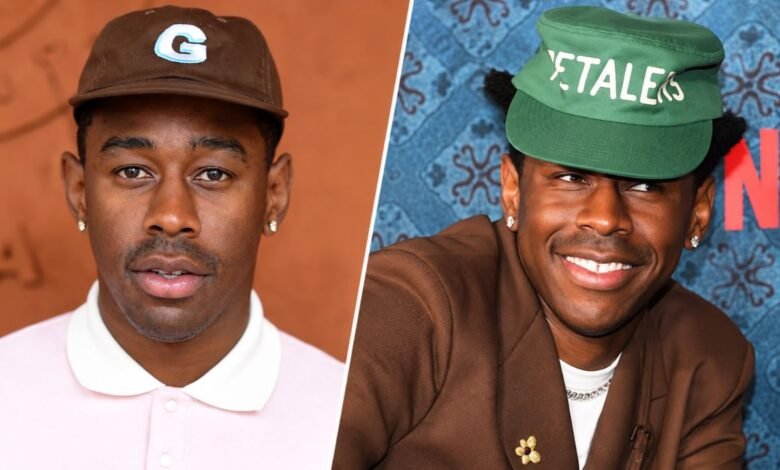
Tyler, the Creator Biography: Early Life, Music Career, Albums and More
Tyler, the Creator is an American rapper, singer, songwriter, record producer, director, fashion designer, actor and entrepreneur who has built a career across several areas of entertainment. He first gained attention through the Odd Future collective and his early independent music before developing into one of the most distinctive artists of his generation. His career has included successful albums, television projects, fashion brands, a major music festival and film roles. From Bastard and Goblin to Flower Boy, IGOR, CHROMAKOPIA and DON’T TAP THE GLASS, his work shows a clear evolution in both sound and personality.
Who Is Tyler, the Creator?
Tyler Gregory Okonma, professionally known as Tyler, the Creator, was born on March 6, 1991, in Hawthorne, California. He became widely known in the late 2000s as one of the central figures behind Odd Future, a Los Angeles-based creative collective that included several influential young artists. His early music attracted attention because of its dark themes, unconventional production and provocative lyrics. Over time, however, Tyler developed a much broader artistic style that incorporated melodic songwriting, soul, jazz, R&B and experimental production.
Music is only one part of Tyler’s career. He has worked in television, animation, fashion, directing, festival production and film, often taking an active role behind the scenes. His clothing brands helped turn his personal style into a business, while Camp Flog Gnaw became an important live event connected to his audience. His move into acting and filmmaking has added another dimension to a career that continues to expand.
Tyler, the Creator Early Life and Childhood
Tyler grew up in the Los Angeles area and developed creative interests while he was still a child. One unusual detail about his childhood is that he would create imaginary albums before he had a professional music career. He designed album covers, created track lists and imagined how long individual songs would be. This early habit of building complete fictional projects later became a recognizable part of the way he approached real albums.
His interest in music became more serious during his teenage years. Tyler taught himself to use music production software and learned how to play piano, giving him the tools to experiment without depending completely on other musicians. Production eventually became just as important to his identity as rapping. Instead of seeing himself only as a performer, he developed into an artist who wanted control over the sound, arrangement and presentation of his work.
Tyler’s School Years
Tyler attended numerous schools while growing up in California, experiencing different environments before developing the creative circle that eventually became important to his career. During his teenage years, he became interested in music, skateboarding, design and other forms of youth culture. These interests later became visible in his clothing, album artwork and visual projects.
The internet also played a major role in the development of his early career. Online platforms gave young musicians an opportunity to release their own work and find audiences without waiting for traditional record companies. Tyler used that environment effectively, building attention around music that sounded different from much of the mainstream hip-hop of the period.
How Tyler, the Creator Started His Music Career
Tyler’s earliest major project was Bastard, which he released independently in 2009. The project introduced listeners to a darker and more confrontational version of his artistic personality. He used fictional characters, disturbing themes and unusual production to create a style that immediately separated him from many other young rappers.
His breakthrough became larger with Goblin in 2011. The album included “Yonkers,” one of his most recognizable early songs, and its music video helped introduce him to a much wider audience. Goblin also reached No. 5 on the Billboard 200, proving that Tyler’s internet-based following could translate into mainstream attention.
The early Tyler, the Creator sound was deliberately controversial. His music often relied on shock value, dark humor and exaggerated characters. Although some of the material from this period was divisive, it helped establish a recognizable identity that allowed Tyler to stand out in a crowded music scene.
Odd Future and Tyler’s Rise to Fame
Odd Future became one of the most important foundations of Tyler’s career. The Los Angeles collective brought together several young musicians and creative personalities, including Earl Sweatshirt, Frank Ocean, Syd and Lionel Boyce. Tyler became one of its most visible members and helped shape the group’s aggressive, independent approach.
Odd Future was more than a music group. The collective created videos, clothing, comedy and other forms of entertainment around its music. Its internet presence allowed the members to communicate directly with fans and develop a strong community without following the usual path taken by major-label artists.
The collective also helped Tyler understand the value of building a complete creative environment around his work. Music, humor, fashion and visual design could exist together instead of being treated as separate industries. That idea remained important throughout the rest of his career.
Tyler, the Creator and Lionel Boyce
Tyler’s connection with Lionel Boyce is an important part of his early creative story. The two met while attending high school and eventually became collaborators. Their relationship developed through the Odd Future era and continued through television and animation projects.
Lionel Boyce became involved with Loiter Squad and The Jellies!, while Tyler continued developing his own music and creative businesses. Their long-running collaboration shows that Tyler has often worked with people from his early creative circle even after his career became much larger.
This connection is also useful when looking at Tyler’s approach to creativity. He has consistently built teams around himself rather than working entirely alone. Many of the people connected to his early career later developed their own careers in entertainment.
Loiter Squad and Tyler’s Television Career
Tyler expanded into television through Loiter Squad, a sketch-comedy series connected to Odd Future. The program ran from 2012 to 2014 and gave Tyler an opportunity to combine comedy, acting, writing and directing.
Loiter Squad was important because it demonstrated that Tyler was interested in entertainment beyond music. The show allowed him to experiment with characters and short-form comedy while working alongside other members of his creative circle.
The experience also prepared Tyler for later work in animation and other visual formats. He continued appearing in projects such as Kidding and Big Mouth, showing that acting and comedy remained important parts of his creative interests.
Tyler, the Creator’s Musical Evolution
One of the most important parts of Tyler’s biography is the major change in his music over time. His earliest projects were built around dark themes, aggressive performances and deliberately provocative characters. His later albums became more melodic, emotional and musically detailed.
His studio albums show this development clearly:
- Bastard — 2009
- Goblin — 2011
- Wolf — 2013
- Cherry Bomb — 2015
- Flower Boy — 2017
- IGOR — 2019
- Call Me If You Get Lost — 2021
- CHROMAKOPIA — 2024
- DON’T TAP THE GLASS — 2025
Rather than repeating the same formula, Tyler used each album to explore a different direction. His production became more sophisticated, his songwriting became more personal and his willingness to experiment increased. That evolution helped him maintain attention long after the initial excitement surrounding Odd Future had faded.
Wolf and Cherry Bomb
Wolf was released in 2013 and showed that Tyler was already moving beyond the sound of his first two major projects. The album still contained elements of his earlier storytelling and character work, but the production was more ambitious and varied.
Cherry Bomb followed in 2015 and pushed his experimentation even further. The project included loud and abrasive moments alongside softer and more melodic passages. It was not designed to be an easy listen from beginning to end, but it became an important step toward the sound Tyler would develop on his later albums.
These two albums are useful when explaining Tyler’s development because they sit between his controversial early period and the more mature musical direction that followed. They show an artist testing ideas rather than settling into one formula.
Flower Boy Changed Tyler’s Career
Flower Boy arrived in 2017 and became one of the biggest turning points in Tyler’s career. The album moved away from much of the shock-focused presentation associated with his earlier work and placed greater attention on melody, relationships, emotions and personal experiences.
The production incorporated elements of soul, jazz, R&B and alternative music while still retaining Tyler’s recognizable approach. Songs such as “See You Again” helped introduce his music to listeners who may not have connected with his earlier projects.
Flower Boy also received a Grammy nomination for Best Rap Album. More importantly, it changed how many listeners viewed Tyler as an artist. He was no longer simply the provocative young rapper associated with Odd Future; he was becoming a mature producer and songwriter capable of creating emotionally detailed music.
IGOR and Tyler’s First Grammy
Tyler released IGOR in 2019, creating another major stage in his career. The album reached No. 1 on the Billboard 200 and built a distinctive musical world around themes of attraction, jealousy, uncertainty and complicated relationships.
The production combined hip-hop with soul, funk, electronic sounds and melodic vocals. Tyler’s voice was often treated as another instrument within the production rather than being presented in the traditional rap format.
IGOR eventually won the Grammy Award for Best Rap Album. The award confirmed that Tyler’s artistic transformation had reached a level of recognition far beyond the underground audience that first discovered him.
Call Me If You Get Lost
In 2021, Tyler released Call Me If You Get Lost, an album that brought more of his traditional rap energy back into the foreground. The project featured DJ Drama and used a mixtape-inspired presentation while still retaining the detailed production that had become associated with Tyler.
The album reached No. 1 on the Billboard 200 and earned Tyler another Grammy Award for Best Rap Album. The success demonstrated that his artistic development did not mean abandoning rap; instead, he could move between different styles while keeping his own identity.
Call Me If You Get Lost was later expanded with The Estate Sale. The additional material allowed Tyler to return to the album’s world and give listeners more songs connected to the original project.
CHROMAKOPIA and a More Personal Direction
CHROMAKOPIA was released in October 2024 and became another major commercial success for Tyler. The album reached No. 1 and continued the personal direction that had become increasingly visible in his songwriting.
The project explored themes connected to family, relationships, fame, privacy and growing older. Tyler used the album to consider experiences that become more relevant as a person moves from youth into adulthood.
Musically, CHROMAKOPIA continued Tyler’s habit of blending different styles. Hip-hop remained central, but elements of soul, jazz, funk and R&B were woven into the production. The result was another album that sounded different from his earlier projects while remaining recognizably his own.
DON’T TAP THE GLASS
Tyler followed CHROMAKOPIA with DON’T TAP THE GLASS in July 2025. The album provided a noticeable change in mood, leaning more heavily toward energetic production, movement and rhythm.
Compared with the more reflective character of CHROMAKOPIA, the new project was designed around a more immediate musical experience. Tyler continued to experiment with production while avoiding simply repeating the style of his previous album.
The project became another successful release and reached No. 1. Its arrival also demonstrated that Tyler was comfortable releasing new work relatively soon after a major album instead of following a predictable long gap between projects.
Tyler, the Creator Grammy Awards and Achievements
Tyler has won three Grammy Awards from 11 nominations. His wins include Best Rap Album for IGOR, Best Rap Album for Call Me If You Get Lost and Best Album Cover for CHROMAKOPIA.
His Grammy recognition reflects different parts of his career. The two Best Rap Album wins recognize his musical work, while the Album Cover victory highlights the importance of visual presentation in his creative projects.
At the 2026 Grammy Awards, Tyler received six nominations across several categories. His nominations included Album of the Year and Best Rap Album for CHROMAKOPIA, Best Alternative Music Album for DON’T TAP THE GLASS, Best Rap Performance for “Darling, I,” Best Rap Song for “Sticky” and Best Album Cover for CHROMAKOPIA.
Tyler, the Creator as a Fashion Designer
Fashion has been closely connected to Tyler’s career for many years. Through GOLF WANG, he developed a clothing brand that reflects the playful, colorful and unconventional style associated with his music.
The fashion business gave Tyler another way to communicate with his audience. Clothing, album artwork, stage design and music could all contribute to the same creative identity.
His work has also expanded through GOLF le FLEUR*, which became another important part of his fashion and design activities. These businesses show that Tyler’s interest in fashion goes beyond selling merchandise connected to his albums.
GOLF WANG and GOLF le FLEUR*
GOLF WANG developed from the world surrounding Tyler’s music into a recognizable fashion brand. Its designs have become associated with the colorful visual language that has appeared throughout his career.
GOLF le FLEUR* expanded that creative approach into another fashion and lifestyle platform. Together, these projects have helped Tyler establish a business presence that exists independently from his record releases.
Camp Flog Gnaw and Tyler’s Festival Career
Tyler is also the founder of Camp Flog Gnaw Carnival, a major music festival associated with his creative world. The event gives him an opportunity to curate performers and create an environment that reflects his interests.
Camp Flog Gnaw is important because it shows that Tyler is not simply interested in performing at events organized by other people. He has created a platform where music, fashion, food, entertainment and his personal creative style can exist together.
The festival has grown substantially since its early years and has become an important part of Tyler’s career outside the recording studio.
The Jellies! and Animation
Tyler and Lionel Boyce continued their creative partnership through The Jellies!, an animated comedy series. The project allowed them to take the style of humor developed through live-action work and move it into animation.
Animation gave Tyler greater freedom to create unusual characters, situations and visual jokes. It also demonstrated his interest in writing and production rather than limiting himself to appearing in front of the camera.
The Jellies! became another example of Tyler using different entertainment formats to express ideas that would not necessarily fit into his music.
Tyler, the Creator Acting Career
Tyler has gradually expanded his screen career through television and film. His earlier television work included Loiter Squad, while later appearances included projects such as Kidding and Big Mouth.
His acting career became more significant with Marty Supreme, directed by Josh Safdie. The film marked Tyler’s feature-film debut and placed him alongside major film performers.
Moving into film was a natural development considering Tyler’s previous experience with directing, comedy, animation and visual storytelling. His career has repeatedly moved between music and other forms of entertainment, so acting represents another stage in that process.
Tyler, the Creator and Marty Supreme
Marty Supreme became one of Tyler’s most notable film projects. The movie was directed by Josh Safdie and features Timothée Chalamet in the lead role, with Tyler appearing as part of the cast.
The project introduced Tyler to a larger film audience and demonstrated that his ambitions extend beyond music and television. His feature-film work also gives him another environment in which to develop characters and participate in storytelling.
For a biography, Marty Supreme is important because it represents a new phase rather than simply another acting credit. Tyler had already spent years building experience in music videos, comedy and television before making the move into a major feature film.
Tyler, the Creator and FC Barcelona
In October 2026, Tyler became part of an unusual collaboration involving GOLF WANG, Spotify and FC Barcelona. His GOLF branding is being featured on a special Barcelona shirt connected to the El Clásico match against Real Madrid.
The project combines three areas that have become increasingly important to Tyler: music, fashion and visual creativity. It is also different from a traditional celebrity sponsorship because the collaboration involves a broader creative campaign.
The project includes a Tyler-directed short film, a GOLF WANG and FC Barcelona clothing collection and a Barcelona event called Copa De Golf. The limited collection includes 1,899 jerseys, referencing the year FC Barcelona was founded.
Tyler, the Creator’s Recent Career
Tyler’s career remains active and continues to develop across music, fashion and entertainment. Following CHROMAKOPIA and DON’T TAP THE GLASS, he has remained involved in new music and major creative collaborations.
His 2025 period was particularly successful. His CHROMAKOPIA tour reportedly sold more than $175 million in tickets across more than 90 sold-out arenas in North America, Europe and Asia.
Apple Music also named Tyler its 2025 Artist of the Year after recording more than 4.5 billion minutes of listening time from fans during the relevant period. The recognition reflected the size of his global audience and the continued interest in his work.
What Makes Tyler, the Creator Different?
Tyler’s career stands out because he has consistently tried to control multiple parts of the creative process. He is not simply a rapper who records songs and performs them on stage. He has worked as a producer, director, writer, actor, fashion designer and festival creator.
Some of the major areas of his career include:
- Music production and songwriting
- Television and comedy
- Animation
- Music video direction
- GOLF WANG
- GOLF le FLEUR*
- Camp Flog Gnaw
- Acting and film
- Festival curation
- Visual design
- Large-scale creative collaborations
His willingness to change has also played a major role in his longevity. The Tyler of Bastard and Goblin sounds very different from the Tyler who created Flower Boy and IGOR. The later versions of Tyler became more personal, more melodic and more interested in creating complete artistic worlds.
Tyler, the Creator’s Influence and Legacy
Tyler’s influence can be seen in the way independent artists approach creativity, branding and audience building. His early success demonstrated that an artist could use the internet to create a dedicated following before becoming fully established within the traditional music industry.
His career also challenged the idea that a musician has to choose one creative field. Tyler has moved between music, fashion, comedy, television, animation, festivals and film while maintaining a recognizable identity.
Perhaps the strongest part of his legacy is his willingness to evolve. He did not remain dependent on the controversial style that first made him famous. Instead, he gradually introduced more musical depth, emotional writing and visual ambition, allowing his career to grow with him.
Tyler, the Creator FAQs
What is Tyler, the Creator’s real name?
Tyler, the Creator’s real name is Tyler Gregory Okonma. He was born on March 6, 1991, in Hawthorne, California.
How did Tyler, the Creator become famous?
Tyler became famous through his independent music and the Odd Future collective. His early projects, especially Bastard and Goblin, helped him build an underground following, while “Yonkers” brought him wider mainstream attention.
How many Grammy Awards has Tyler, the Creator won?
Tyler, the Creator has won three Grammy Awards. His wins include Best Rap Album for IGOR, Best Rap Album for Call Me If You Get Lost and Best Album Cover for CHROMAKOPIA.
What are Tyler, the Creator’s most famous albums?
Some of his most important albums include Bastard, Goblin, Wolf, Cherry Bomb, Flower Boy, IGOR, Call Me If You Get Lost, CHROMAKOPIA and DON’T TAP THE GLASS. Flower Boy and IGOR are especially important because they marked major changes in his musical style.
Is Tyler, the Creator an actor?
Yes. Tyler has worked in television and film, including Loiter Squad, Kidding and Big Mouth. He also made his feature-film debut in Marty Supreme, adding another major area to his already diverse entertainment career.
Conclusion
Tyler, the Creator has developed one of the most varied careers in modern entertainment. He began as a young independent artist connected to Odd Future and gradually became a successful rapper, producer, director, fashion designer, festival creator and actor. His albums show a clear progression from the provocative sound of Bastard and Goblin to the emotional and highly produced work found on Flower Boy, IGOR and CHROMAKOPIA.
His career outside music is just as important to understanding his success. GOLF WANG and GOLF le FLEUR* gave him a place in fashion, Camp Flog Gnaw allowed him to build his own festival platform, while television, animation and Marty Supreme expanded his work into screen entertainment. His 2026 collaboration with FC Barcelona further shows how far his creative interests have expanded.
What makes Tyler, the Creator particularly interesting is his refusal to remain in one category. He has repeatedly changed his sound, visual identity and professional direction while keeping control over the ideas behind his work. That ability to evolve has allowed him to remain relevant while building a career that reaches far beyond the music that first made his name.